Yesterday, the so-called vishu festival marked the first day of the astronomical year; it is also considered as the harvest festival of Kerala, a southern state in India. Many families of Indian expats from that region celebrate this event here in Dubai.
The festival entails an arrangement called Vishukani, consisting of items that are supposed to bring luck for the coming year, such as an oil lamp, mirror, fruits, vegetables, rice, betel leaves and nut and fresh linen - when you see them first thing in the morning, walking with closed eyes to where the arrangement was placed the previous night. Children then seek the blessing of parents and older siblings, and receive small gifts.
According to wikipedia, it is also seen as auspicious to read verses from the Hindu Holy book Ramayanam after seeing the Vishukani. Some believe that the page of the Ramayanam to which you open up will have a bearing on your life in the coming year. And there may be fireworks in the evening in the respective region in India.
One thing I really like about Dubai is that you have many cultures rolled into one city. So you learn about traditions and customs that are not only foreign to a European, but are also originally from other parts of the world. Happy Vishu everybody!
Wednesday, 15 April 2009

Tuesday, 14 April 2009
More than words
 The Arabic language does not just look exotic for most Western people, but also lends itself to creating other works of art - apparently, especially in the context of the Quran, which is seen as a great work of poetry in itself (and earlier formed the basis for children's language education, starting with the short verses and then moving on to the longer ones...). The fish above is actually made up of a verse from the Quran.
  And I was also impressed by how the holy book itself was designed over the centuries. In Manama, the capital of the Kingdom of Bahrain, there's a so-called House of the Quran. This cultural center and museum exhibits Qurans from as far back as the 7th century - the beginning of Islam. There are countless ways of caligraphy artistry, from always beginning each line with Alef, the first letter of the Arabic alphabet, to arranging the words in a way that the same expressions face each other through all the pages when you close the book, to intricate patterns and ornaments drawn by hand, to Quran versions consisting of only 30 pages, or verses written on chick peas. Not to mention the different materials or dozens of languages and dialects.
 By the way, to give you a nice bit of trivia knowledge which I quite liked: Did you know the first Quran printed with movable type was produced in Germany, in 1694? And Martin Luther had his hands in producing the first Latin version of this holy book.
It has to be something about the letters: Even a graffiti which I discovered in a small alley of Manama's old quarter looks like a piece of art. I just hope the example below does not mean anything negative...

Heated debate about media law
The work of the media is a subject of debate here, especially now as a new UAE draft media draft law has just been criticised by Human Rights Watch (HRW).
While the US-based rights watchdog says the proposed law is a "significant" improvement over existing legislation, it still restricts press freedoms, according to HRW. In their view, there are positive aspects such as that journalists should not be pressed to reveal their sources; and the law would also reduce the number of areas which could result in penalties from 16 to three. However, HRW criticize that there can be high fines of up to Dhs 5 million if journalists are found to have personally insulted the UAE's President or other senior federal government officials or crown princes. And other 'content based restrictions' remain, including information that could harm the economy; also, media need to provide security deposits to be allowed to run - resulting in what the watchdog described as government controls on the registration of media outlets. Some say parts of the proposed law remain too vague, so the initiative would represent a "missed opportunity".
Many who read this will probably see the points of HRW. Interestingly, the National Media Council reacted the same day the HRW report came out - stating it welcomes "informed discussion and debate" but also emphasizing that the draft law "has not been designed for applications in other societies, with different value systems, but is only applicable within the context of the United Arab Emirates".
Personally, what I find enriching about such things is how your own beliefs are challenged; coming from a certain culture, we do have certain values and perspectives, a strong feeling of what is right or wrong, which you become only fully aware of when you expose yourself to the notions and convictions of others.
It makes you think about how you think.
While the US-based rights watchdog says the proposed law is a "significant" improvement over existing legislation, it still restricts press freedoms, according to HRW. In their view, there are positive aspects such as that journalists should not be pressed to reveal their sources; and the law would also reduce the number of areas which could result in penalties from 16 to three. However, HRW criticize that there can be high fines of up to Dhs 5 million if journalists are found to have personally insulted the UAE's President or other senior federal government officials or crown princes. And other 'content based restrictions' remain, including information that could harm the economy; also, media need to provide security deposits to be allowed to run - resulting in what the watchdog described as government controls on the registration of media outlets. Some say parts of the proposed law remain too vague, so the initiative would represent a "missed opportunity".
Many who read this will probably see the points of HRW. Interestingly, the National Media Council reacted the same day the HRW report came out - stating it welcomes "informed discussion and debate" but also emphasizing that the draft law "has not been designed for applications in other societies, with different value systems, but is only applicable within the context of the United Arab Emirates".
Personally, what I find enriching about such things is how your own beliefs are challenged; coming from a certain culture, we do have certain values and perspectives, a strong feeling of what is right or wrong, which you become only fully aware of when you expose yourself to the notions and convictions of others.
It makes you think about how you think.
One camel, two camels, clone camels!
 Frontpage news today: Scientists in Dubai have cloned a camel.
Hardly surprising that this would happen here, given the long shared history with those animals and the enduring popularity of camel racing, of which I had gotten an idea while at the camel market in Al Ain. In Dubai, there's also a race track. But I still haven't made it to a race, and I just read the season might be over already. What a pity. It's supposed to be quite a sight.
Thursday, 9 April 2009
Happy Easter!
 I wish you a happy Easter time! Even though this holiday, obviously, is not that relevant here. Still I have off this Sunday, and plan to explore more of this region over the coming three days. Stay tuned - and click here for more info about public holidays in the UAE.
Fasten your seat belts, please
.jpg) This is an "OK-now-that-the-journalists-have-left-the-cockpit-I-can-just-really-quickly-do-what-I-wanted-to-do-the-whole-time-and-take-a-picture-of-myself-sitting-in-the-pilot's-seat" photo.
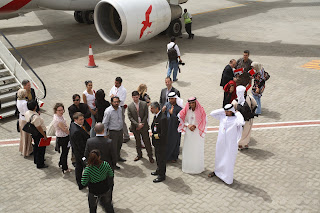
This is an "OK-now-that-the-journalists-have-left-the-cockpit-I-can-just-really-quickly-do-what-I-wanted-to-do-the-whole-time-and-take-a-picture-of-myself-sitting-in-the-pilot's-seat" photo.The team here organised an Air Arabia press event recently, with about 15 journalists visiting the airline's offices in Sharjah. Of course I had no objections when I was asked if I wanted to come along, and enjoyed the opportunity to look behind the scenes and chat with some journalists.
Wednesday, 8 April 2009
Divorce Rate
There's an article about the 'alarming' divorce rate in the UAE on the National's front page today.
While there appears to be no nationwide information, figures released in the emirate of Sharjah (just east of Dubai) now indicate that about every third marriage (34%) ended in divorse in 2008 there - up from 26% in 2001.
Someone from Europe might wonder: So what!? In Germany, the divorce rate (number of divorces in relation to marriages) was about 50.1% in 2007. In England and Wales, that figure for the same year is even 55.5% (with people there, by the way, being on average older than in Germany when they marry).
I'm not sure about why this is a cause of concern - though there may be a few indications in tradition and region. Sharjah is considered to be one of the more conservative emirates in the UAE. And in traditional culture, marriage is considered to be the most important event in people's lifes. If you speak to locals - be it in the UAE, or also in Bahrain, people will be very surprised to hear that you're not married at a certain age (by the way, if you are married and have no children, it may well happen that people will pity you and even propose to take another women, who might be more able to bear a child).
According to what I saw at the Bahrian National Museum, marriage is a central part of traditional societies, which is also reflected in the elaborate and lengthy traditional ceremonies and celebrations around marriages - it creates the framework for raising children, security for the women, is the nucleus of family life - and a strong bond between families, particularly in earlier times more often than not with clear economic and political intentions. Traditionally, as I understood that, marriage is a societal institution and one of its main pillars. And a divorce represents a failure of this institution.
So this may be a rough layman's idea of why divorce could be seen as something critical and therefore why the figure mentioned in the article is perceived as very high. In Western cultures, in contrast, we emphasize the individual and personal development much more, so different styles of life are accepted - including choosing to end a marriage. Again, as I said in earlier posts, I don't want to judge as to what is better or not here.
It's a pity it doesn't say in the report what the reasons behind this rising figure is, though. What are the drivers behind that development?
Is it because couples give up when they encounter problems with each other, as maybe it becomes socially more accepted to end a marriage? I can only speculate. Maybe some see something like this as a reason.
One of the steps the authorities now have pledged to take is to recruit more marriage counsellors.
While there appears to be no nationwide information, figures released in the emirate of Sharjah (just east of Dubai) now indicate that about every third marriage (34%) ended in divorse in 2008 there - up from 26% in 2001.
Someone from Europe might wonder: So what!? In Germany, the divorce rate (number of divorces in relation to marriages) was about 50.1% in 2007. In England and Wales, that figure for the same year is even 55.5% (with people there, by the way, being on average older than in Germany when they marry).
I'm not sure about why this is a cause of concern - though there may be a few indications in tradition and region. Sharjah is considered to be one of the more conservative emirates in the UAE. And in traditional culture, marriage is considered to be the most important event in people's lifes. If you speak to locals - be it in the UAE, or also in Bahrain, people will be very surprised to hear that you're not married at a certain age (by the way, if you are married and have no children, it may well happen that people will pity you and even propose to take another women, who might be more able to bear a child).
According to what I saw at the Bahrian National Museum, marriage is a central part of traditional societies, which is also reflected in the elaborate and lengthy traditional ceremonies and celebrations around marriages - it creates the framework for raising children, security for the women, is the nucleus of family life - and a strong bond between families, particularly in earlier times more often than not with clear economic and political intentions. Traditionally, as I understood that, marriage is a societal institution and one of its main pillars. And a divorce represents a failure of this institution.
So this may be a rough layman's idea of why divorce could be seen as something critical and therefore why the figure mentioned in the article is perceived as very high. In Western cultures, in contrast, we emphasize the individual and personal development much more, so different styles of life are accepted - including choosing to end a marriage. Again, as I said in earlier posts, I don't want to judge as to what is better or not here.
It's a pity it doesn't say in the report what the reasons behind this rising figure is, though. What are the drivers behind that development?
Is it because couples give up when they encounter problems with each other, as maybe it becomes socially more accepted to end a marriage? I can only speculate. Maybe some see something like this as a reason.
One of the steps the authorities now have pledged to take is to recruit more marriage counsellors.
Subscribe to:
Posts (Atom)

